



Compulsory Third Party (CTP) insurance helps people injured in motor vehicle accidents (caused wholly or partly by another driver) access insurer-funded treatment, rehabilitation and compensation.
All claims are assessed individually. The amount you may receive depends on the type and severity of your injury and your personal situation. If you were partly responsible for the accident, the compensation you are entitled to will be reduced.
Talk to your doctor about what you need now and what you might need into the future, and find out how much it is likely to cost.
Discuss any queries with the CTP insurer or your lawyer (if you are legally represented).
Refunds to government agencies
If your claim is successful, the CTP insurer may be required to repay certain benefits that have already been paid to you by other government agencies.
This can include:
- Medicare (for CTP claims that settle for more than $5,000)
- Centrelink benefits
- WorkCover Queensland payments.
These amounts will be deducted from your total settlement by the CTP insurer, rather than being paid to you on top of your compensation.

Treatment and rehabilitation
Treatment and rehabilitation under the CTP insurance scheme is aimed at returning you to your pre-injury function. With approval from the CTP insurer managing your claim, you can access services such as medical consultations, physiotherapy, occupational therapy, psychological counselling, return to work programs and medication. Your claim can include past (from the date of accident) and future treatment and rehabilitation.
If the CTP insurer has accepted liability for your claim or has agreed to fund rehabilitation without admitting liability, they will cover rehabilitation expenses provided the services meet the following criteria:
- Reasonable and appropriate: the treatment must align with your injury and be suitable for your recovery, as determined by medical evidence.
- Accident-related: there must be sufficient evidence that the service directly relates to injuries sustained in the motor vehicle accident, including any aggravation of pre-existing conditions.
- Clinically appropriate: the service should be recommended as part of your treatment plan, with no unnecessary duplication or contraindications.
- Likely benefit: the treatment should have clear goals and timeframes, with an expectation of improving recovery, function, independence or return to work. Progress should be demonstrated where applicable.
- Right provider: the provider must have appropriate qualifications or registration and be reasonably accessible.
- Reasonable cost: fees must align with standard market rates and be consistent with what is typically charged to the public.
Each request for treatment or rehabilitation is assessed individually, based on the specific circumstances and evidence provided. To support your claim, you may need to provide receipts or other documentation to the CTP insurer.
For more information, see Guideline for CTP insurers: Reasonable and appropriate rehabilitation and treatment.

Loss of income
If you have sustained injuries from a motor vehicle accident, you may be eligible to claim compensation for lost income. This includes wages lost due to being unable to work, whether temporarily or permanently, as a result of the accident. To calculate your lost income, the CTP insurer will consider your pre-accident earnings, employment history and future work potential.
It’s also important to think about how much time you’ve already taken off work, as well as any time you may still need to recover. Unlike WorkCover claims, lost wages under CTP insurance aren’t paid as you go. Instead, they are considered during negotiations with the CTP insurer when working towards settling your claim, and the final amount will depend on the agreement reached between you and the CTP insurer.
General damages (pain and suffering)
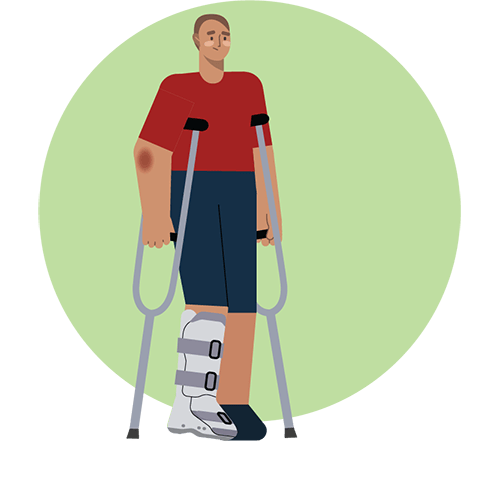
General damages are payments to compensate you for things like pain, suffering and loss of quality of life. Not all injuries qualify for general damages – only those that are serious enough.
General damages are calculated using the Injury Scale Value (ISV) system. The ISV system is designed to:
- ensure similar injuries are assessed consistently
- provide fair assessments for different injuries that have similar impacts on a person’s life.
The ISV assigns points from 0 to 100, where 0 means the injury is not severe enough for compensation, and 100 represents the most serious and life-changing injuries.
To work out your ISV, you can use the following resources:
- Schedule 3 of the Civil Liability Regulation 2025: this provides instructions for calculating the ISV for an injury.
- Schedule 4 of the Civil Liability Regulation 2025: this lists the injury categories and ISV ranges for specific injuries to help assess the ISV for your situation.
- Civil Liability Indexation Notices (indexed annually): this helps you convert the ISV number into a dollar value. To view Civil Liability Indexation Notices see Legislation.
If you need more information about calculating your ISV or general damages for your claim, contact the CTP insurer or your lawyer (if you have one).

Legal costs and disbursements
Depending on the final settlement amount, you may be able to recover some of your reasonable legal costs (if you have engaged a lawyer) and disbursements (also called outlays) from the CTP insurer.
Please note that if you are able to recover some of these fees, the disbursements must be reasonably incurred, and you must have documentary evidence to prove that the disbursement was paid (e.g. a receipt for the amount you paid for a medico-legal report from a doctor).
For more information on what legal costs and disbursements may be claimed, see About legal advice.
Treatment by a public hospital or emergency services
Treatment of Queensland CTP claimants at a public hospital, or by Queensland Ambulance Service or other emergency services, is covered by the Hospital and Emergency Services levy (included in the CTP insurance premium). You should not be billed.
For people who have lost a family member
If a person dies in a motor vehicle accident in Queensland, caused (fully or partly) by another driver, the CTP insurance scheme may cover:
- reasonable funeral costs
- financial support: if you relied on the person who passed away for income. This could include claims from a surviving spouse (including de facto partners), dependent children or other dependants.
- domestic support: if you relied on the person who passed away for domestic services e.g., childcare, home maintenance etc.
If you need more information, contact the CTP insurer of the vehicle that may have been at fault or your lawyer (if you have one).